AI face recognition offers a smarter, safer and more efficient way to manage your team. From enhanced security to time-saving automation, the benefits go far beyond just clocking in and out.
These biometric attendance systems make it easy to maintain accurate visitor logs, simplify payroll processing, and improve access control across your site — all while streamlining attendance tracking.
Ultimately, you can ensure your workforce data is reliable, your operations are compliant, and your people are where they need to be, when they need to be there.
But with so many solutions available, navigating the options can feel overwhelming, especially if this modern approach is new to you.
Here, we break down the basics of an AI facial recognition attendance system. Read on to discover how it works, why more Australian businesses are embracing it, and how it can support your team’s productivity and peace of mind.
What is AI face recognition?
AI face recognition is a technology that uses artificial intelligence to identify or verify a person’s identity based on their facial features. It works by analysing and measuring unique facial characteristics in images or videos.
In the context of business attendance, AI facial recognition serves as an advanced solution for tracking employee check-ins and check-outs.
By scanning an employee’s face, the system accurately records attendance, eliminating the need for manual timekeeping or traditional methods like ID cards.
This biometric software not only enhances security but also prevents time theft practices such as buddy punching – when one employee clocks in or out for another, often leading to inaccurate attendance records and payroll discrepancies.
This technology can be integrated into company time clocks, mobile apps, or other workplace platforms to ensure reliable and efficient attendance management.
Beyond time and attendance tracking, AI facial recognition is widely used for user authentication, device security, and onboarding processes across industries.
How does AI face recognition work?
Facial recognition follows three core steps: detection, analysis, and recognition.
- Detection: The system uses cameras or sensors to capture an image or video of an employee’s face.
- Analysis: Advanced algorithms measure and map unique facial features, such as the distance between the eyes or the shape of the jawline, creating a digital facial template.
- Recognition: This template is compared to stored, approved face data in its database. If a match is found, it automatically records the employee’s check-in or check-out time.
Let’s take a closer look at each step.
1. Face detection
Face detection is the first step in facial recognition, where algorithms pinpoint and isolate faces within an image, video or 3D data.
Powered by computer vision, this AI technology can identify a single face or multiple faces, even when viewed from the front or side.
Computer vision enables machines to “see” and interpret visual data—identifying people, objects, and patterns with precision like a human, but at far greater speed and scale.
2. Facial feature analysis
Facial recognition systems analyse an image of a face by mapping its unique geometry and key landmarks that set it apart from other objects. This process identifies specific points and proportions, like the:
- Space between eyes
- Length from forehead to chin
- Alignment of the nose and mouth
- Depth and curve of eye sockets
- Angles of cheekbones
- Contours of the lips, ears, and jawline
Once mapped, the system transforms these measurements into a faceprint—a unique numerical signature that’s as individual as a fingerprint. This digital code is what allows the system to match faces with near-perfect accuracy.
For business attendance systems, this step supports seamless verification so employees can clock in and out easily while eliminating the risk of errors or impersonation.
3. Employee recognition
Each employee’s unique facial features are compared to a secure database of stored images to find a match.
In a business setting, imagine an employee arriving at work—rather than swiping a card or punching a clock, the system scans their face and instantly matches it to their registered company profile.
It can even check for duplicates or unauthorised faces to prevent someone from sneaking in under someone else’s identity.
This seamless, hands-free process ensures accurate attendance tracking while enhancing workplace security and efficiency.
Benefits of an AI-based face recognition attendance system
An attendance management system using face recognition can transform how your business tracks attendance by combining speed, accuracy, and convenience.
From enhancing security to supporting flexible work environments, this technology offers a smarter way to manage workforce attendance.
Easier security
AI-based facial recognition systems streamline attendance tracking by eliminating the need for manual check-ins, ID cards, or passwords.
The technology verifies employees quickly and ensures only authorised individuals can clock in, enhancing workplace security.
Compared to traditional biometric methods like fingerprint or retina scans, facial recognition is faster, touch-free, and more convenient.
It can also support multifactor authentication, providing an extra layer of protection for businesses.
Superior accuracy
Facial recognition delivers far greater accuracy by preventing errors and eliminating common time theft tactics.
Unlike mobile numbers, email addresses, or IP-based identification, facial recognition ensures employees are verified based on their unique physical features. This precise method reduces inaccuracies and makes attendance records more reliable.
Smoother integration
Facial recognition technology integrates seamlessly with existing security and attendance systems, making it a flexible solution for businesses.
For instance, devices with front-facing cameras, like smartphones or tablets, can easily support facial recognition algorithms, reducing the need for specialised hardware.
More streamlined attendance reports
The system automatically generates attendance records that are easy to access and manage. These reports simplify payroll processing, making it more efficient to track hours worked, leave, and overtime.
Greater flexibility for workers
Facial recognition systems allow employees to clock in from any location, whether they’re in the office, working from home, or on-site.
This flexibility is especially valuable for businesses with remote teams, field staff, or hybrid work environments, ensuring that attendance tracking remains accurate and effortless.
Business applications of AI face recognition
Facial recognition technology is revolutionising visitor management by boosting security, efficiency, and ease of use. Here are some of its key applications:
Flagging fraud
Facial recognition helps businesses verify user identities during account creation, ensuring the person is who they claim to be. It can also monitor for suspicious activity, re-verifying user identity when potential risks arise, like unauthorised logins or account anomalies.
Strengthening cybersecurity
By replacing traditional passwords with a biometric login method that analyses unique facial features, AI face helps to fortify cybersecurity.
This makes it highly effective for securing devices, accounts, and sensitive data. Common uses include unlocking smartphones, workplace systems, and encrypted platforms.
Facilitating access to records
Facial recognition simplifies access to sensitive records while making sure that only authorised individuals can view or update information.
For instance, in healthcare settings, this technology streamlines patient registration by quickly verifying identities. This curbs wait times and removes the need for physical identification cards or manual data entry.
Simplifying transactions
Facial recognition can streamline transactions by eliminating passwords and PINs.
For example, in the world of banking, users can authorise payments, access banking apps, or withdraw cash from ATMs easily with a scan of their face.
This maximises convenience and minimises the risk of fraud, as there are no credentials for hackers to steal.
Accelerating check-ins and clearance
Facial recognition technology is transforming how organisations manage identity verification for a faster and more efficient experience.
For example, airports often use facial recognition to speed up passenger check-ins and border clearance.
By matching a traveller’s face to their e-passport or biometric data, these systems cut down waiting times, enhance security, and enable smooth, automated access through terminals.
How accurate is AI face recognition?
AI facial recognition delivers exceptional accuracy under optimal conditions, though real-world performance can be influenced by various factors.
Here are the main factors that can affect accuracy:
- Lighting: Accuracy is highest under consistent illumination with no shadows or glare.
Resolution: High-resolution images are needed to ensure precise facial feature extraction. - Setting: Stable backgrounds with minimal visual distractions are best.
- Workwear: Faces should be visible and free from obstructions like hats, glasses, or masks.
- Aging: Over time, natural changes to facial features, such as wrinkles or shape shifts, may reduce match success for older reference photos.
- Facial expressions: Modern systems can adapt to most expressions, but exaggerated or extreme variations can still pose challenges.
- Pose: Facial recognition works best with a clear, front-facing image. Angled or side profiles may impact accuracy unless the face recognition time attendance system is trained to recognise multiple perspectives.
By maintaining consistent conditions and using high-quality data, businesses can leverage accurate AI facial recognition technology to track employee attendance with confidence.
What is a similarity score?
Similarity scores, also known as confidence scores, measure how likely two facial images are to belong to the same person in a facial recognition system. It is generated using AI algorithms that compare facial features and determine the degree of similarity.
- Higher scores indicate a stronger likelihood of a match.
- Lower scores suggest uncertainty and may require further verification.
In business attendance systems, confidence scores help ensure accuracy by setting a threshold level for automated matches.
For instance, a system might only accept matches with a score above 98% to confirm an employee’s identity reliably. If the score falls below this threshold, it can flag the image for further review, often requiring human evaluation to ensure that no errors occur.
This process ensures precise, dependable attendance tracking while maintaining flexibility to handle edge cases.
Is AI facial recognition safe?
Yes, AI facial recognition is considered one of the safest biometric identification methods. That’s because it uses unique mathematical patterns to convert facial features into encrypted data for reliable identification.
To enhance security and protect privacy, facial recognition systems can:
- Anonymise and encrypt facial data to prevent unauthorised access.
- Utilise detection technology to verify that the face being scanned belongs to a live person, preventing spoofing attempts using photos or videos.
With measures like this in place, AI facial recognition safeguards sensitive employee data while ensuring precise attendance tracking.
Maximise attendance system efficiency with Pulse Presence
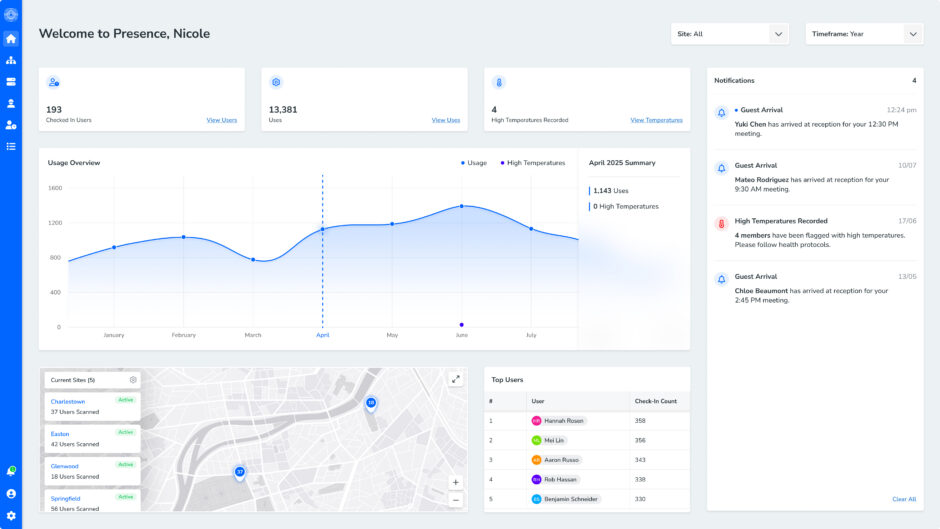
Pulse Presence is a revolutionary visitor management system that makes attendance tracking swift, secure and seamless.
With advanced facial recognition, RFID compatibility, and seamless integration with your current setup, this real-time solution delivers personalised visitor experiences at any workspace—from retail stores to construction sites.
Learn more about Pulse Presence or contact our team for a free demo today.