Technology’s rapid evolution has redefined the role of finance, creating infinite opportunities. But with it comes a demand for greater efficiency. Sticking to outdated financial processes puts your organisation at risk of falling behind competitors who embrace digital innovation.
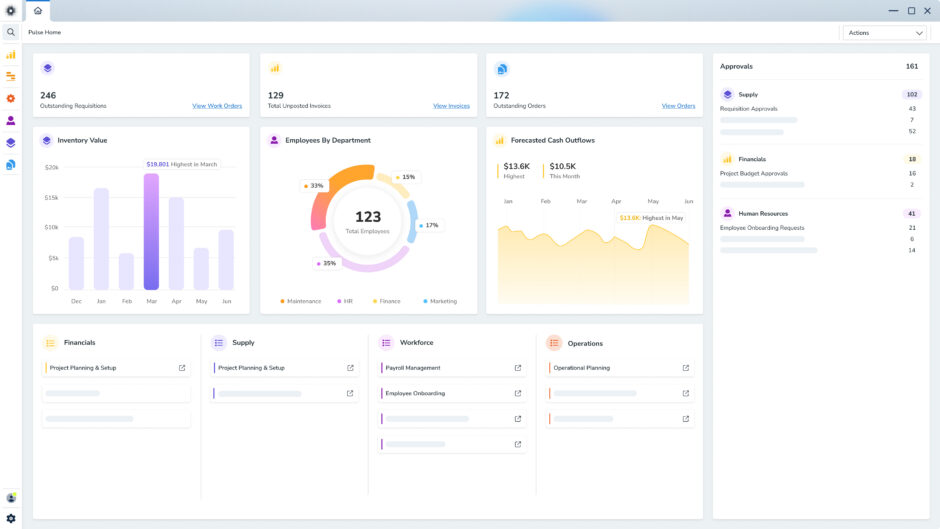
That’s why finance transformation is no longer optional—it’s a strategic necessity. And Pulse Financials makes it simple. This purpose-built ERP module streamlines all financial processes with real-time data syncing and time-saving automation. No third-party add-ons required.
Here, we’ll explore the concept of finance function transformation, the factors driving its adoption, and why it’s critical to prioritise it in 2025.
While there’s no universal blueprint, every financial department can follow core principles to lead the charge toward smarter, data-driven decision-making.
What is finance transformation?
Finance transformation involves strategic initiatives that optimise the finance function to better support a company’s overall goals. It focuses on rethinking processes and upgrading systems to make finance a more agile, value-driven part of your business.
This transformation can include:
- Restructuring the finance operating model and workflows.
- Enhancing financial capabilities and skill sets.
- Modernising finance systems and technologies.
- Aligning teams, tools, and processes to create greater synergy.
Gone are the days when finance teams were confined to endless spreadsheets and manual calculations. With the adoption of modern technologies, finance professionals can automate repetitive tasks, streamline processes, and give more time to high-impact activities.
This drives positive change across the entire organisation, delivering greater efficiency, flexibility, and insight.
But only if it’s successful.
Keep reading to discover the most common obstacles standing in your way.
Barriers to effective finance transformation
Understanding the challenges that can arise during finance digital transformation is the first step toward overcoming them.
By recognising these obstacles and implementing proactive ways to surmount them, you can ensure a smoother, more successful result.
A disconnect between stakeholders
Effective communication is key to aligning all parties on the transformation vision.
Ensure stakeholders, business partners, and finance leaders clearly understand the objectives and scope of the transformation—including what it is and isn’t designed to achieve, such as cost savings or technology upgrades.
Open, consistent dialogue fosters agreement and keeps everyone moving toward a shared goal.
Lack of cross-functional awareness
Finance teams often work in silos without fully considering the ripple effects of their changes.
Successful transformation requires analysing how processes connect across departments. Integrate workflows and assess interdependencies to ensure changes create value organisation-wide, not just within finance.
Insufficient staff resources
Finance process transformation is a major initiative that demands dedicated time and effort. Relying on current staff to manage transformation tasks alongside their daily responsibilities often leads to burnout, delays, and mediocre results.
To avoid this, allocate specialised resources or teams to focus solely on transformation efforts.
Resistance to change
Change can be met with resistance, particularly when it disrupts familiar workflows.
A solid change management plan helps address employee concerns, prepare them for new processes, and provide the necessary support. Implement changes gradually, giving teams time to adapt, learn, and gain confidence at each step.
Failure to address legacy issues
Outdated data, inefficient processes, and inaccuracies must be tackled early in the finance transformation journey. Ignoring these problems can derail progress and result in non-value-adding activities.
Prioritise cleaning up data and resolving inefficiencies to lay a solid foundation for meaningful improvements.
A CFO who doesn’t embrace modern practices
Even experienced finance leaders can struggle to keep pace with evolving technologies and industry practices. Busy schedules often leave little room for continuous learning, but staying informed is essential to leading a successful transformation.
To build a culture of learning, allocate regular time for your team to explore new tools and technologies together.
Whether it’s a weekly session or a monthly workshop, fostering a top-down commitment to learning ensures your team stays competitive and adaptable.
After all, the CFO should champion innovation and digital tools that drive progress.
Key components of finance transformation
Finance transformation is a complete overhaul of strategy, people and processes, leveraging technology and smarter practices to boost efficiencies and reduce costs.
While the scale of change might be intimidating, it’s a must for organisations looking to stay ahead in the modern market.
Here are the core factors to consider when taking on this digital transformation.
Strategy
A well-designed finance transformation strategy helps organisations pinpoint weaknesses, prioritise necessary improvements, and build a clear operating model to support business goals while streamlining core financial activities.
A modern approach needs to leverage digital technologies to create an agile and efficient function capable of meeting changing business demands. This includes enhancing planning, forecasting, and decision-making processes to align with organisational growth and complexity.
Start by asking these essential questions:
- Where can we make the biggest impact?
- Identify the areas where your finance function can advance its efficiency and results.
- How well does my team deliver what internal stakeholders need?
- Evaluate your performance on critical tasks that support other business functions. Focus on the activities that drive the most value.
- Which external partners and solutions will best support our goals?
- Determine which vendors, technologies, or service providers can help accelerate your transformation initiatives with measurable results.
A creative, focused strategy can transform finance into a growth engine—unlocking insights, fuelling stronger decisions, and positioning your business ahead of the curve in an ever-changing landscape.
Operations
When driving finance transformation, many organisations overemphasise technology or organisational structure while neglecting other critical aspects of the operating model.
To prepare your team for this change, it’s essential to consider every component of your operating model — not just the obvious ones.
After all, there’s no “one-size-fits-all” solution for finance transformation. Each organisation’s operating model differs depending on its business context, talent pool, regulatory environment, and unique history.
That said, successful transformations often share universal principles.
Below are key areas to focus on when designing an effective operating model:
Work processes
Build a more transparent, collaborative culture. Encourage agile and lean methodologies while refining workflows, behaviours, and team dynamics to improve productivity and adaptability.
Decision rights
Define who makes decisions, how they are made, and the process for resolving conflicts. Clear decision-making authority supports alignment with strategy and reduces bottlenecks.
Organisational structure
Establish clear roles, reporting lines, and collaborative networks to enable smooth communication and execution across the organisation.
Tools and tech
Specify the applications, systems, and assets your teams need — and what they don’t. Align these tools with your operating model to enhance efficiency.
Financial management
Plan and monitor transformation funding, budget allocation, and cost recovery strategies. Ensure all investments are tied directly to strategic objectives.
Performance management
Develop a performance framework that drives accountability and ensures the operating model delivers on its strategic goals.
Sourcing strategy
Decide what to outsource and how to partner with third-party providers to maximise value and efficiency.
Tactical alliances
Identify key partnerships and establish processes to ensure they deliver tangible results and lasting value.
Location strategy
Determine where key people and assets will be based globally to optimise resource distribution and operational effectiveness.
Talent and skills
Identify the capabilities, skills, and expertise your team needs to execute effectively. Focus on upskilling for the evolving demands of an autonomous finance function. We’ll talk more about this in the next section.
Finance teams
Equip your finance department with the right skills and talent to deliver real results. To keep up with the rise of automation, AI, and robotics, finance professionals need to evolve beyond traditional roles.
Finance teams of the future require more than just number-crunching expertise. Teams must embrace advanced technical skills, real-time data analysis, and modern tools that enable faster, smarter decision-making.
They’ll need:
- Strong business acumen
- Digital proficiency in robotic process automation (RPA), machine learning (ML), and natural language processing (NLP)
- Advanced problem-solving abilities for complex, ambiguous challenges
As routine tasks are increasingly automated, these capabilities will enable finance teams to focus on judgment-based, high-value work that requires critical thinking and strategic insight.
To build digitally skilled teams, CFOs need to take a proactive approach. This means looking beyond immediate digital gaps and reimagining the finance function’s value in a digital-first world.
By clearly defining and promoting a compelling digital value proposition, finance leaders can attract, develop, and retain top talent who thrive in a modern, autonomous environment.
Leadership
Unlock faster results and maximise the impact of your finance transformation efforts. While CFOs rank transformation as their top priority this year, turning vision into reality isn’t easy.
Rising complexity across organisations often slows progress and keeps teams from hitting their transformation goals.
Finance is changing rapidly — think digitisation, shifting workflows, and evolving skill sets. To make sure your efforts pay off, here’s where to focus:
Bring it all together
Balancing new systems, processes, people, and structures is no small task.
Success comes from smart prioritisation, staying flexible as focuses shift, and partnering with external experts who can help you navigate the journey.
Take a big-picture view of redesign opportunities, and commit to a culture of ongoing progress.
Cut through the complexity
Finance can’t transform in silos. As digital tools reshape the landscape, scaling operations means teams need to work differently — across departments, projects, and even locations.
Redesign roles, refine team structures, and align skills with improved processes and technology for a more connected approach. Get everyone on board
Transformation is a long game, and keeping momentum can be tricky. Great CFOs empower their teams with strong governance, clear roles, and a culture where change feels natural.
Equip your people with the resources, support and technology they need to drive transformation forward.
Technology
Many organisations face ongoing challenges with fragmented and unreliable data. Business leaders often struggle to locate the right data or question its accuracy, relying on labour-intensive solutions like custom programming or manual fixes.
Finance transformation offers a way forward by leveraging emerging technologies to address these data management hurdles and streamline operations.
With technology evolving faster than most budgets allow, finance leaders must prioritise solutions that deliver maximum value, creating a modular strategy with a multi-year vision to guide implementation.
With cloud technology, finance teams can build scalable, flexible, and cost-effective infrastructure.
Unlike traditional on-premises systems, cloud platforms are designed to meet today’s real-time demands.
With embedded analytics and streamlined processes, cloud solutions empower teams to act faster and more efficiently.
You don’t need to go to a 3rd party add-on. Check with your current provider first. Sometimes, it can be more cost-effective to get their advice and input. That way, you’re not paying additional tech fees before better utilising your existing subscriptions. Ask yourself, are we using the current product effectively? Companies like Pulse help you do that. They can customise to get the best practice.
6 best practices for finance transformation
Transforming your finance function doesn’t have to be daunting. Here are some best practices to get it right:
1. Integrate your ERP and EPM systems
Integrate your ERP and enterprise performance management (EPM) systems to streamline processes and reporting.
Without integration, ERP handles transactions one way while EPM manages budgets and forecasts differently. This disconnect creates confusion and multiple versions of the truth.
Integrated systems like Pulse deliver a clear, unified view of your data, driving accuracy and business growth. Get ERP and EPM functionality in a single integrated package.
2. Automate budgeting processes
Budgeting doesn’t need to be a burden. Use a cloud-based ERP system like Pulse that automatically collects, validates, and organises data.
These tools enable team collaboration and replace outdated spreadsheets, making budgeting faster, more accurate, and far less stressful.
3. Swap spreadsheets for modern tools
Spreadsheets like Excel are flexible but lack real-time updates, collaboration, and security—all essential for today’s finance teams.
Switch to a cloud-based ERP system to centralise data, eliminate errors, and improve reporting. Modern tools save time, reduce manual effort, and ensure accurate, up-to-date insights.
4. Automate financial close activities
Manual financial close processes are slow and error-prone. Automating tasks like data categorisation improves accuracy, speeds up reporting, and gives finance teams time to focus on analysis.
With automation, leadership gets timely, reliable insights to guide decisions.
5. Empower teams with self-service reports
Stop wasting time on endless ad hoc reports. Self-service reporting tools allow teams to generate their own reports, uncover trends, and make quick decisions.
This frees up finance professionals to focus on strategic tasks while giving other teams the autonomy they need to stay informed. More on this below.
6. Shift focus to high-value tasks
Finance teams often get bogged down in tracking routine metrics like invoices and payments. Instead, adopt analytics-driven tools that turn raw data into actionable insights.
Focusing on high-value activities helps uncover growth opportunities, improve performance, and drive smarter business decisions.
The benefits of digital transformation in the finance industry
A well-executed finance transformation can bring major benefits to your business’s daily operations.
From curbing costs and accelerating processes to enhancing data accuracy and decision-making, this approach can revolutionise how finance teams operate.
Let’s dive into each advantage:
Boost efficiency
Centralising financial data into a single, accessible hub fosters better collaboration between teams and enables remote work capabilities. Combined with streamlined processes, this approach enhances overall efficiency.
Plus, automating repetitive, time-consuming activities frees up your finance team to focus on high-value, strategic initiatives. This shift enables them to contribute to more meaningful initiatives that push your organisation forward.
Cut costs
Finance transformation delivers clear, measurable value by reducing operational costs and making better use of resources.
By applying actionable insights to improve workflows, finance teams run leaner for greater profitability.
Moreover, automation and streamlined processes bring cost-saving opportunities across departments, while remote work options can cut overhead costs and optimise payroll management.
Quicker processes
Finance transformation drives faster workflows by aligning processes with modern, purpose-built technologies.
With optimised systems in place, your business can eliminate slow, costly bottlenecks and reduce delays in financial operations.
These improvements also support a smoother customer experience, fostering trust and satisfaction while enhancing performance.
Reliable data for smarter decisions
Today’s businesses are inundated with massive volumes of data from internal systems, websites, and external sources like social media.
Digital transformation equips finance teams with the tools and time to analyse this data, ensuring it’s accurate, relevant, and actionable.
With deeper, more reliable insights, your team can better understand financial performance and align strategies to meet business goals.
Greater agility
Finance transformation empowers organisations to adapt to changing market conditions, regulatory requirements, and business challenges.
By leveraging flexible processes and systems, finance teams can respond proactively and position the organisation for long-term success.
Minimise manual errors
Standardising and automating financial processes helps reduce human error and increase overall accuracy.
By establishing a single, centralised source of truth for financial data, businesses can eliminate inconsistencies and improve stakeholder confidence in reporting.
How to create a finance transformation roadmap
Embarking on a finance transformation journey requires more than just adopting the latest technology. To achieve meaningful results, you need a well-defined, long-term strategy that aligns with your organisation’s goals.
A successful finance transformation roadmap is built through deliberate actions, carefully sequenced phases, and incremental milestones that deliver tangible outcomes.
By breaking this upgrade into structured workstreams, your business can move forward methodically with measurable progress.
Here are some key steps to creating a practical roadmap:
- Assess your current state: Start by documenting where your finance function stands today. Conduct a thorough analysis of your processes, technologies, and workforce. Evaluate staff competencies, capacity, and areas for improvement to create a solid baseline.
- Envision your future: Define where you want your finance department to be over the next 5 to 10 years.
- Set clear objectives: Outline your goals, taking into account both internal and external factors. Align these with broader business objectives, shifting focus from historical spending patterns to deploying resources that support your corporate vision.
- Explore your options: Use a gap analysis to identify the discrepancies between your current capabilities and desired outcomes. Weigh up various approaches to close it. Balance risk and reward to make informed decisions.
- Select the best path forward: Collaborate with your project team to choose the most effective approach for achieving your goals. Prioritise markets, services, and products that will generate the highest value for your business. Ensure your chosen strategy is practical, achievable, and aligned with the overall business priorities.
- Manage stakeholder expectations: Instead of trying to satisfy every stakeholder, focus on shaping realistic expectations. Guide internal customers to prioritise what they truly need, ensuring resources are directed toward high-impact initiatives.
With clear goals, continuous evaluation, and a focus on delivering value, you’ll be well-positioned to transform your finance function effectively.
Accelerate finance transformation with Pulse
To stay competitive and drive strategic decisions in 2025, finance transformation is key. Modern technology allows you to automate tedious tasks and leverage comprehensive data that powers performance across the business.
By embracing innovation, adopting the right tools, and continuously adapting, finance teams can evolve into key partners for driving business success.
Pulse Financials is an automated, scalable solution tailored to operations of any size—from small startups to global conglomerates.
Developed over 35 years, this security-certified system integrates accounting, budgeting, asset management, and reporting across any currency. All on one unified platform.
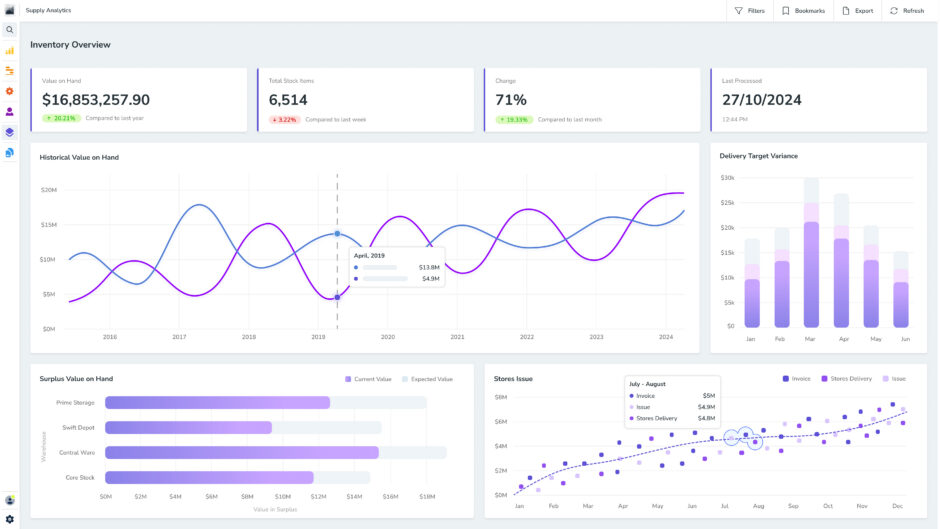
Plus, it can be easily paired with Pulse Analytics. With real-time data synchronisation, information entered anywhere is readily accessible system-wide. With a single source of truth, you can gain full financial visibility for smarter decision-making.