Juggling multiple software tools, chasing down data, or making decisions without a clear picture of performance?
An Enterprise Resource Planning (ERP) system unifies and automates core operations in one simple platform for real-time, business-wide visibility. In turn, it’s easier to stay productive, agile and in control.
Here, we explore the benefits of ERP systems and explain when it’s time to upgrade. Keep reading to learn how this innovative software can help to streamline your operations, boost transparency, and drive long-term growth.
What is an Enterprise Resource Planning system?
ERP (Enterprise Resource Planning) is a type of business software that brings all your core operations into one centralised system, with a suite of integrated modules that are each designed to manage a particular function.
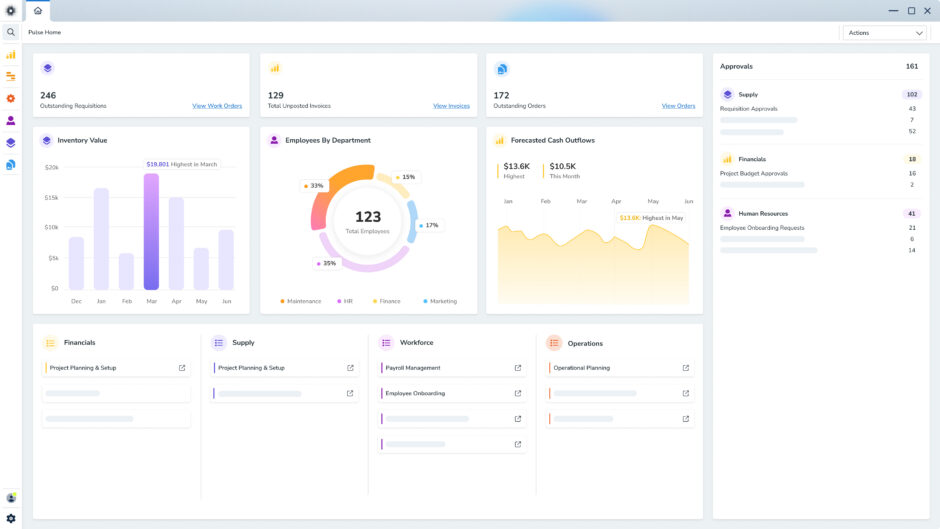
From accounting and HR to inventory and production, information flows between departments in real time to deliver a single, accurate source of truth at any moment. You can quickly see how operations are performing, identify inefficiencies, and make informed decisions based on reliable data.
An ERP system also helps you automate workflows, save time and reduce manual errors, with flexible configurations structured to grow with your business.
Whether for a local startup or a global conglomerate, this unified approach enhances productivity, visibility, and scalability.
The benefits of ERP software in 2026
The merits of ERP systems are manifold. With cloud access, real-time reporting, and automation built in, this modern solution helps businesses move faster, reduce manual work, and make smarter decisions.
Here are 13 of the key benefits of using an ERP system today:
Gain a single source of truth
One of the main advantages of an ERP system is having one reliable place for all your business data. Without it, information is often scattered across spreadsheets, emails, and separate systems.
That leads to duplication, inconsistencies, and a constant question of which version is correct. It also slows teams down, as they spend time searching for information instead of using it.
With an ERP, data is entered once and then flows across all business functions. Everyone is working from the same numbers, in the same format, updated in real time.
This creates clarity. Teams can see what’s happening across the business without needing to ask for updates.
It also reduces errors and manual effort. As information moves automatically between functions, there’s less need for re-entry and fewer chances for mistakes.
Get real-time insights, tailored to your business
Most businesses have reporting in place, but it’s often too late or too generic to be truly useful.
An ERP system presents live data across the entire business. As activity happens, whether it’s a sale, a purchase, or a stock movement, your reports update automatically. You’re always looking at what’s happening now, not what happened weeks ago.
These real-time ERP reporting tools shift your business from reactive to proactive. Instead of waiting for problems to show up in last month’s reports, you’re identifying and addressing them while there’s still time to make a difference.
ERP solutions also give you the flexibility to focus on what matters most to your unique business.
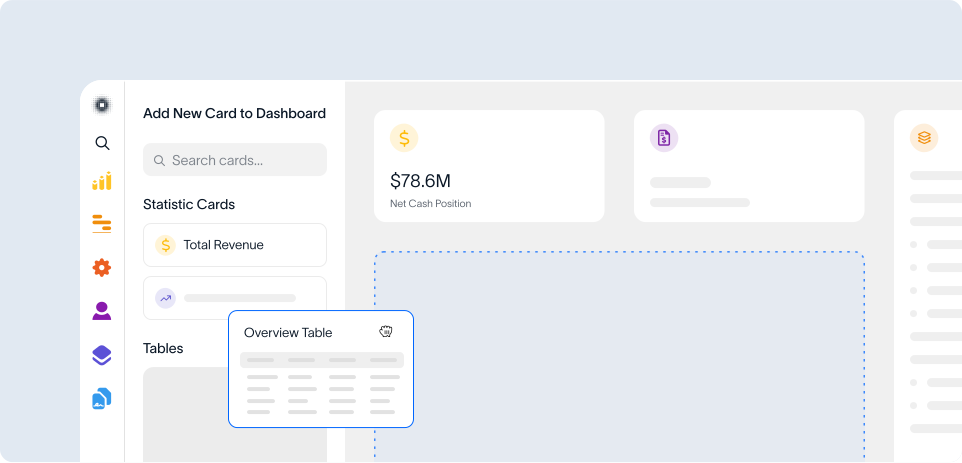
Rather than relying on standard reports, you can tailor dashboards and metrics around your priorities, understand what’s driving results and spot opportunities that might otherwise go unnoticed.
Boost operational efficiency with automation
If you look closely at where time is lost in most businesses, it’s usually in the same places: manual data entry, duplicated work, and processes that rely on people handing things over to each other.
Instead of treating each task as a separate step, ERP software connects them. Information is entered once and then moves through the integrated system automatically, triggering the next action without needing to be retyped or checked multiple times.
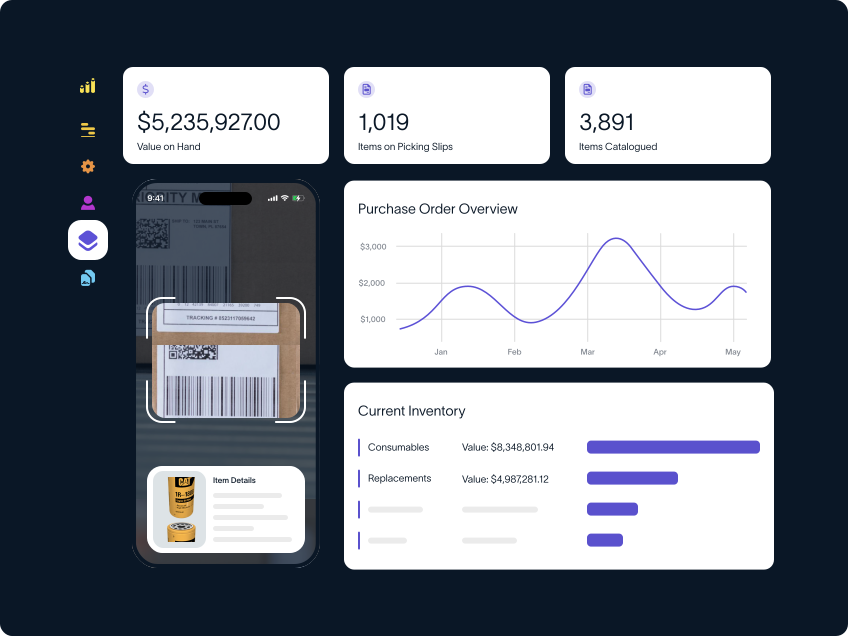
Take purchasing as an example. Creating a purchase order doesn’t just sit in isolation. It flows through to inventory, updates stock levels when goods are received, and feeds directly into accounts. There’s no need to re-enter data at each stage, and far less chance of something being missed.
This has a direct impact on how quickly work gets done. Repetitive tasks move faster because they’re not waiting on manual processes, and your team isn’t tied up chasing information or approvals.
It also improves accuracy. When business processes are automated, there are fewer opportunities for human error, which means less rework and fewer costly mistakes.
Improve financial management and forecasting
Strong financial control rests on reliable numbers. An ERP system unites all your financial activity and ties it directly to what’s happening across the business.
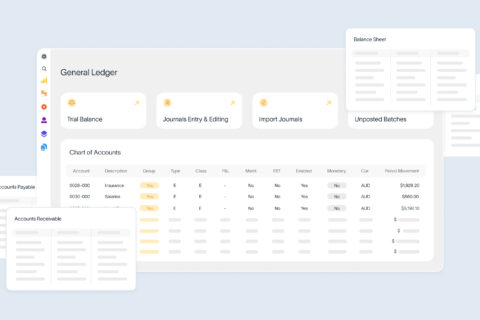
Every sale, purchase, and movement of stock is recorded automatically, giving you a clear, up-to-date view of your financial position at any time.
With clearer insight into cash flow, costs, and profitability, you can make more informed calls around pricing, investment, and long-term strategy.
Forecasting also improves. As projections are based on consistent, business-wide data, they flag real trends you can act on earlier. See where demand is heading, understand cost pressures, and reallocate resources before issues escalate.
Enjoy cost savings
For many businesses, ERP quickly proves its value by helping to reduce costs across the board, not through one big change, but by fixing dozens of small inefficiencies.
It starts with automation. Routine tasks like data entry, invoicing, approvals, and reporting are handled within the system, which reduces manual effort, cuts down on errors, and lowers administrative overhead. Your team spends less time on repetitive work and more time on tasks that actually add value.
ERP also replaces multiple disconnected systems with a single platform. Instead of paying for and maintaining several tools, everything runs through one system, which can reduce software, IT, and training costs over time.
Where the real savings come from, though, is visibility. When you can see exactly what’s happening across the business, it becomes much easier to spot where money is being lost. That might be excess stock sitting on shelves, inefficient purchasing, or rushed orders that drive up costs.
With better data, planning improves as well. You can order more accurately, avoid overproduction, and keep inventory levels balanced, reducing both waste and cash tied up in stock.
Together, these improvements create a more cost-efficient operation end-to-end.
Structure for business growth
As your business grows, your systems need to keep up without slowing you down. Whether you’re adding new products or expanding into new locations, a well-implemented ERP gives you the flexibility to change direction without disruption.
Instead of stitching together new systems as your business evolves, an ERP solution keeps everything connected and consistent as complexity increases.
Introduce new modules, bring more users into the system, and adjust workflows without replacing your core platform, adding hardware or calling on IT support.
Strengthen teamwork
Without ERP, teams often have to rely on separate tools and data sources. That creates gaps in communication, duplicated work, and delays while people chase information. It’s not that teams don’t want to work together; it’s that the systems get in the way.
An ERP platform removes those barriers by connecting departments through shared data and processes. Everyone can see what’s happening across the business without needing to ask around or switch between systems.
This transparency changes how teams interact. It’s easier to spot issues early, step in to help, and coordinate without constant back-and-forth.
Deliver better customer service
Customer expectations are higher than ever, and slow or inconsistent service stands out quickly.
An ERP system can centralise all your customer information, from contact details to order history and past support tickets. That means your team can answer questions faster, provide a more personalised experience, and avoid sending customers in circles.
It also improves reliability. With accurate inventory and order tracking, customers are far more likely to get the right product on time.
The flow-on effects are simple. Smoother service, higher customer satisfaction, and more repeat business.
Support sustainability
Sustainability has shifted from a “nice to have” to a business priority. Today, leadership teams are under increasing pressure from boards, investors, customers, and regulators to reduce environmental impact and show measurable progress.
ERP systems play a practical role in this. By centralising data from across your entire company, this software makes it simple to track resource usage, monitor waste, and improve how materials, inventory, and business operations are managed.
This clarity can support more eco-friendly decisions, whether that’s reducing overproduction, improving energy efficiency, or tightening supply chain planning.
In fact, IBM research shows that organisations achieving the strongest results in both sustainability and financial performance were more likely to have well-embedded ERP systems in place.
The key takeaway? When your data is unified and visible, it’s easier to run a more efficient and responsible business.
Standardise business-wide processes
Many businesses rely on fragmented processes that have evolved over time, not because they’re efficient, but because they’ve always been done that way.
Moreover, the same task can be handled differently by each team, or even by individuals within the same department. This inconsistency leads to errors, delays, and extra work.
An ERP system gives you the opportunity to rethink business processes, remove unnecessary steps, and build standardised workflows.
Everyone follows the same steps, using the same data, within the same system. This improves accuracy, reduces manual effort and mistakes, and makes it easier to train new staff.
With greater consistency and visibility, teams are better aligned and able to work towards the same outcomes.
Support business data security and compliance
An ERP system strengthens security by bringing all your information into one controlled environment, instead of leaving it scattered across spreadsheets, emails, and disconnected systems. With everything in one place, it’s easier to protect, monitor, and maintain consistency throughout your business.
From a compliance perspective, ERP also makes life easier. Records are accurate, up to date, and easy to find, which simplifies reporting. Built-in audit trails track every action, while approval workflows and role-based permissions help enforce proper business processes.
You can manage who sees and edits specific information, ensuring employees only have access to what they need. This reduces the risk of errors, misuse, or unauthorised changes.
For organisations operating in regulated industries, this level of control is essential. Reduce the risk of errors, misuse, or unauthorised changes, while supporting compliance with evolving standards.
Optimise supply chain management
Supply chain issues rarely happen in isolation. A minor delay, a stock miscount, or a missed order can quickly ripple through the rest of your business.
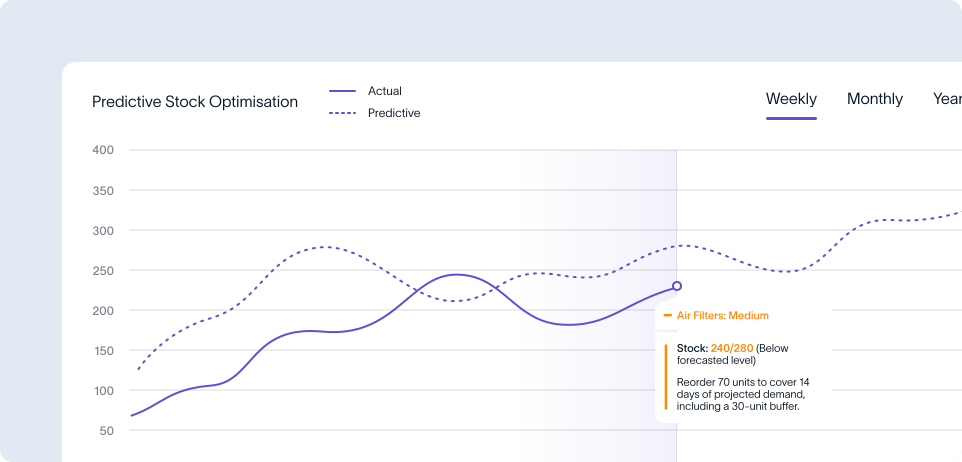
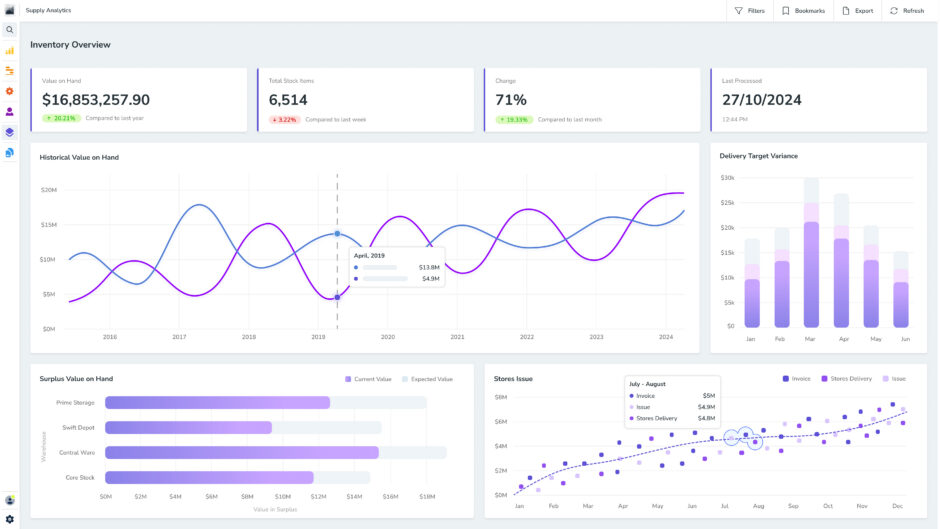
An ERP solution helps you stay ahead of this by sharing a real-time view of your entire supply chain. You can see what stock is on hand, what’s already committed to customers, and what’s still on the way. This makes it easier to avoid over-ordering, prevent stockouts, and keep inventory at the right levels without tying up cash unnecessarily.
It also improves how you work with suppliers. With clear visibility over purchase orders, lead times, and past performance, you can plan more confidently and communicate expectations more clearly. That usually leads to more reliable deliveries and fewer last-minute surprises.
As everything is connected, issues are easier to spot early. If something is stalled or demand changes, you can adjust quickly by reallocating stock, updating orders, or keeping customers informed.
The end result is a supply chain that’s more predictable, proactive and straightforward to manage.
Enhance mobility
Whether it’s on a job site, in a warehouse, or travelling between locations, many work decisions need to be made on the spot. Waiting until someone gets back to a desk slows everything down and creates unnecessary gaps in communication.
A modern ERP removes that friction by enabling your team to access critical information wherever the job takes them.
With tools like the Pulse Mobile App, your team can carry core system functionality with them on-site. They can check stock, review and approve purchase orders, confirm deliveries, and respond to issues in real time, without relying on someone back in the office.
That means fewer delays, less back-and-forth, and faster decisions on the move. Your team stays connected, informed, and productive, anywhere.
FAQs
An ERP system is a strong fit for your business if your current systems are slowing you down, creating data gaps, or making it tough to scale.
A simple way to assess this is to look at six key areas:
- Data accuracy: If your reports don’t match or require manual reconciliation, an ERP provides a single, reliable source of truth.
- System connectivity: If your tools don’t talk to each other, ERP software connects them, improving communication and reducing double-handling.
- Business growth: If you’re expanding, an ERP helps you scale without breaking existing processes or adding unnecessary admin.
- Customer experience: If delays or internal issues are affecting service, ERP systems streamline operations so you can respond faster and more accurately.
- Cost control: If you’re looking to reduce overheads, ERP improves efficiency across finance, inventory, purchasing, and operations.
- Outdated technology: If your current software is no longer supported, flexible, or fit for purpose, ERP software offers a smart, streamlined and flexible alternative.
Ultimately, if you’re dealing with fragmented legacy systems, inconsistent data, or growth challenges, an ERP system can help deliver immediate and long-term value.
ERP software benefits any business that manages multiple processes, departments, or large volumes of data, no matter the sector. That said, it’s especially valuable in industries where coordination, compliance, and real-time visibility are critical.
These include:
- Mining: ERP systems are vital for managing large-scale assets, equipment maintenance, and compliance requirements across remote operations. They provide visibility over site performance, workforce scheduling, supply logistics, and safety reporting, helping reduce costly downtime and operational risk.
- Manufacturing: ERP systems connect production schedules, bill of materials, procurement, and inventory in one place. This helps manufacturers reduce downtime, avoid stock shortages, improve demand forecasting, and maintain tighter control over production costs and margins.
- Distribution and wholesale: For distributors, ERP improves order accuracy, automates inventory replenishment, and provides real-time visibility across warehouses. It also helps optimise freight, reduce carrying costs, and ensure customers receive the right products on time.
- Construction: ERP platforms support job costing, contract management, procurement, and on-site resource allocation. This allows construction businesses to track project profitability, manage subcontractors, and keep timelines and budgets under control.
- Professional services: Service-based businesses use ERP to manage project timelines, allocate staff, track billable hours, and streamline invoicing. This improves utilisation rates, cash flow, and overall project profitability.
- Industrial and field services: ERP helps coordinate technicians, track equipment in the field, and manage service schedules. With mobile access, teams can update job status in real time, improving response times, asset performance, and customer satisfaction.
Choosing the right ERP solution starts with understanding your business needs and selecting a solution that fits both your current operations and future growth plans.
Here’s what to consider when choosing a new ERP system:
- Define your requirements: Identify the processes you need to improve, such as finance, inventory, or project management. Be clear on what problems you’re trying to solve.
- Look for industry-specific features: Many ERP systems are tailored for sectors like manufacturing, construction, or mining. Choosing one that aligns with your industry reduces customisation and improves outcomes.
- Evaluate scalability: Make sure the system can grow with your business, whether that means adding users, locations, or new functionality over time.
- Assess vendor and implementation support: A strong implementation partner is critical. Look for providers with local experience, proven results, and ongoing support options in Australia.
Overall, the best ERP system isn’t the one with the most features. It’s the one that fits your business, integrates smoothly, and delivers real, measurable improvements.
ERP implementations can bring significant advantages, but like any major system change, they come with risks if not managed properly.
The most common risks include:
- Poor planning or unclear requirements: Without a clear scope, projects can drift, leading to delays and missed expectations
- Data migration issues: Inaccurate or incomplete data can affect reporting and day-to-day operations
- Low user adoption: If staff aren’t trained or engaged, the system won’t be used effectively
- Budget overruns: Costs can increase if timelines blow out or extra customisation is required
The good news is that you can minimise these risks with the right approach. Start with clear business goals, involve key stakeholders early, invest in proper training, and work with an experienced ERP implementation partner like Pulse.
When planned and executed properly, the benefits of ERP far outweigh the risks, making it a valuable long-term investment for most businesses.
Take advantage of ERP software with Pulse
As businesses scale, the cracks in disconnected systems become harder to ignore. Reporting slows down, data doesn’t quite match, and getting a clear picture of performance takes more time than it should.
An ERP system like Pulse ERP equips teams with one clear view of your business, with accurate, up-to-date information across every department. When everything is connected, decisions become faster, easier, and far more reliable.
Time to trade multiple legacy systems for one simple ERP platform?
Built and supported in Australia, Pulse ERP brings finance, supply chain, production, maintenance, and HR into one connected platform. With real-time reporting, automated processes, and ongoing local assistance, you can cut manual work, boost efficiency, and stay in control as your organisation grows.
Take the next step towards ERP transformation with a free demo.