Warehouse inventory management is the backbone of any business that manages physical goods. It helps to ensure products are stored correctly and handled efficiently from receiving through to dispatch.
When stock is managed properly, businesses can reduce costly errors, prevent stock shortages, and make better use of valuable warehouse space. It also helps teams work faster, fulfil orders more accurately, and maintain the level of service customers expect.
Here, we explore how warehouse inventory management works, the key processes involved, and the strategies your warehouse can use to boost performance.
What is warehouse inventory management?
Warehouse inventory management is the process of tracking, controlling, and organising stock in a storage or distribution centre so that goods can move efficiently from arrival to dispatch.
The goal is to keep the right products available in the right quantities while maintaining accurate records and making the best use of storage space. When done well, it reduces delays, prevents stock shortages, and speeds up order fulfilment.
A typical warehouse inventory management process includes several key activities:
- Receiving goods: Checking incoming shipments, confirming quantities, and recording new stock into the system.
- Inventory tracking: Monitoring where products are stored and how stock levels change as items move through the warehouse.
- Storage management: Organising products into appropriate locations so they are easy to find, access, and replenish.
- Order picking and packing: Selecting the correct items for customer orders and preparing them for shipment.
- Stock control and cycle counting: Regularly checking inventory levels to maintain accuracy and identify discrepancies.
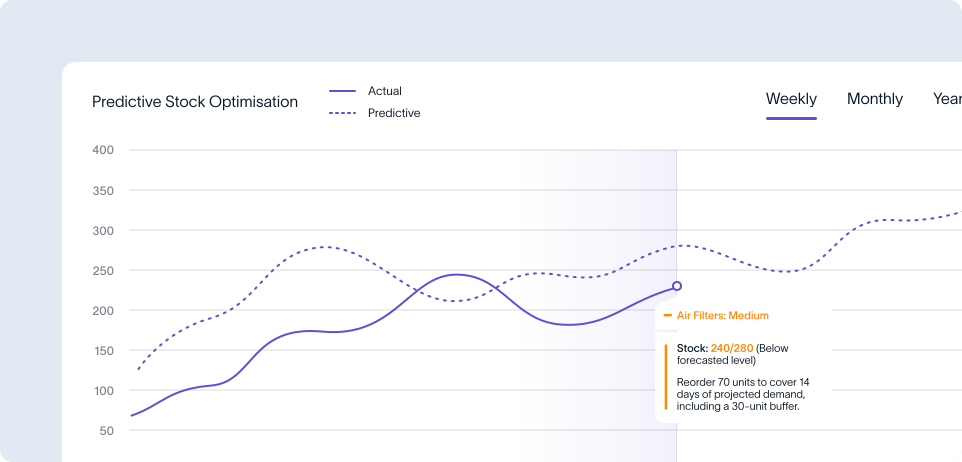
- Demand forecasting: Using historical sales data to predict future demand and maintain optimal stock levels.
What is a warehouse management system?
A warehouse management system (WMS) is software that helps businesses take control of operations and track inventory in real time.
At its core, a WMS connects inventory data, warehouse processes, and staff workflows into one system. It supports everything from receiving deliveries and storing products to picking orders, packing shipments, and updating stock records automatically.
Instead of relying on manual spreadsheets or paper-based systems, a WMS provides live visibility of stock levels and warehouse activity, helping businesses run more accurate and efficient operations.
Typical benefits include:
- Improved inventory accuracy: Real-time tracking ensures stock levels are always up to date, reducing errors and discrepancies.
- Better storage organisation: The system helps allocate the best storage locations for products, making better use of warehouse space.
- Faster order fulfilment: Automated picking and packing workflows reduce delays and help staff locate items quickly.
- Improved labour productivity: Warehouse teams receive clear task instructions, allowing them to work more quickly and with fewer mistakes.
- Lower operational costs: Automation and improved visibility reduce waste, prevent overstocking, and minimise manual work.
- Stronger supplier and customer relationships: Faster order processing and accurate stock levels help businesses deliver more reliable service.
For businesses that manage large volumes of products, a WMS provides the control, visibility, and efficiency needed to run a modern warehouse successfully.
The warehouse inventory management process
A series of connected processes controls how goods move through a warehouse, from the moment they arrive to the moment they leave. Each step plays a role in keeping stock accurate, orders moving, and customers satisfied.
Here’s a clear overview of the warehouse inventory management process:
1. Receiving
Receiving is the first step in warehouse inventory management. It begins when goods arrive from suppliers or manufacturers.
Warehouse staff check deliveries to confirm that the products, quantities, and condition match the purchase order. Any damaged or missing items are then recorded before the stock is accepted.
Once verified, inventory is logged into the warehouse system to provide an accurate record of what has entered the facility.
Key tasks during receiving include:
- Inspecting goods for damage or defects
- Confirming quantities against supplier documentation
- Recording inventory in the warehouse system
- Labelling items with barcodes or tracking identifiers
Ultimately, a strong receiving process prevents incorrect stock from entering the warehouse and sets the foundation for accurate inventory tracking.
2. Put-away and storage
To maximise storage capacity while keeping inventory easy to access, received goods must be stored in the correct location.
That’s why products are placed in designated locations based on factors like SKU, product size, weight, and how frequently items are picked.
Best practices at this stage include:
- Assigning fixed or dynamic storage locations
- Grouping similar products together
- Storing high-demand items near picking zones
- Using shelving, pallet racking, or bins for efficient space use
3. Order processing and inventory tracking
Once a customer places an order, the warehouse management system records the request and prepares it for fulfilment. Orders may arrive through online stores, email, phone, or integrated sales systems. The system then checks available inventory and generates a picking list.
At the same time, inventory tracking tools like barcode scanners, mobile warehouse devices and inventory management software can monitor stock levels and locations in real time. This helps businesses avoid stockouts, reduce overstocking, and maintain accurate inventory records.
4. Picking and packing
Picking and packing are the stages where products are physically prepared for shipment.
Picking involves locating the correct items and quantities in the warehouse using methods like:
- Batch picking: A warehouse worker collects items for multiple customer orders at the same time, reducing repeated trips through the warehouse and improving picking efficiency.
- Zone picking: The warehouse is divided into specific zones, and each worker picks items only within their assigned area before orders move to the next zone.
- Wave picking: Orders are grouped into scheduled picking waves, allowing warehouses to organise picking activities around shipping deadlines, staffing levels, or carrier pickup times.
- Voice-directed picking: Workers wear headsets that provide spoken instructions guiding them to the correct item locations, allowing hands-free picking and improving speed and accuracy.
Once items are picked, the packing process prepares the order for safe delivery. Packing typically includes:
- Verifying the items and quantities
- Protecting products with packaging materials
- Sealing cartons or parcels securely
- Attaching shipping labels and tracking details
Overall, a well-run picking and packing process improves order accuracy and reduces the risk of damaged or returned goods.
5. Shipping and dispatch
At this stage, packaged orders leave the warehouse and enter the delivery network. Warehouse staff confirm that the order is correct, generate shipping documentation, and hand the package to the selected carrier.
Core tasks during dispatch include:
- Final order verification
- Printing shipping labels and documentation
- Assigning parcels to delivery carriers
- Updating tracking information for customers
The goal of this step is to ensure that all orders leave the warehouse quickly and reach customers on time.
6. Inventory replenishment
Inventory replenishment focuses on keeping stock levels high enough to meet demand. When inventory drops below a certain threshold, the business reorders products from suppliers or moves stock from reserve storage to picking locations.
Replenishment decisions are typically based on historical sales data, forecast demand, supplier lead times, and safety stock levels.
Additionally, modern inventory systems can automatically trigger reorder alerts or purchase orders, helping prevent stock shortages.
7. Cycle counting and inventory audits
Cycle counting and inventory audits are used to maintain accurate stock records, which are crucial for forecasting, purchasing, and customer order fulfilment.
Cycle counting involves regularly counting small groups of inventory rather than shutting down operations for a full warehouse count.
Meanwhile, periodic inventory audits compare physical stock levels with the records in the warehouse system.
These processes help businesses:
- Detect inventory discrepancies
- Reduce shrinkage and loss
- Maintain accurate stock records
- Improve overall warehouse control
How to manage warehouse inventory effectively
Successful warehouse operations rely on clear inventory strategies. The right techniques for your warehouse depend on factors like product demand, storage capacity, supply chain reliability, and order volumes.
In Australia, many businesses combine several of the following methods to create a reliable and efficient inventory system:
ABC analysis
ABC analysis is used to prioritise inventory based on its value and importance to the business. This helps warehouse managers focus their attention where it matters most.
Instead of managing every product the same way, this strategy groups items into three categories based on their impact on revenue and demand:
- Category A: High-value, high-demand items that contribute the most to revenue. These products require close monitoring, frequent stock checks, and careful replenishment planning.
- Category B: Moderate-value products with steady demand. These items are managed with balanced oversight and regular inventory reviews.
- Category C: Low-value items that typically move more slowly. These products require less monitoring and can be ordered in larger quantities to reduce handling costs.
This approach helps businesses identify fast-moving products and ensure popular items are always available to meet customer demand.
Just-in-time inventory
Just-in-time inventory (JIT) management focuses on ordering and receiving stock only when it’s needed.
Instead of storing large quantities of inventory, businesses rely on accurate demand forecasting and reliable suppliers to deliver goods when required. This reduces excess stock and frees up valuable warehouse space.
Note that JIT works best when supply chains are stable, and suppliers can deliver inventory quickly.
FIFO and LIFO
FIFO (First In, First Out) and LIFO (Last In, First Out) are inventory rotation methods that determine which stock is used or sold first:
- FIFO: The oldest inventory is sold or used first. This method is commonly used for perishable goods and products with expiry dates, ensuring stock remains fresh and reducing waste.
- LIFO: The most recently received inventory is sold first. This approach is sometimes used for accounting purposes because it can increase the recorded cost of goods sold during periods of rising prices.
Cross-docking
Cross-docking is a logistics method where incoming goods are transferred directly to outbound shipments without being stored in the warehouse.
Products arrive at the receiving dock and are quickly sorted, consolidated, and loaded onto outbound transport.
This strategy is often used for:
- High-volume retail distribution
- Perishable goods
- Time-sensitive shipments
By eliminating storage time, cross-docking reduces handling costs and speeds up delivery times.
Slotting optimisation
Slotting optimisation is the process of strategically placing products within a warehouse to boost picking efficiency.
Instead of storing items randomly, products are positioned based on factors such as demand frequency, size, weight, and picking patterns.
For example:
- Fast-moving items are stored closer to packing areas
- Heavy items are placed in lower storage positions
- Frequently ordered products are grouped together
Well-planned slotting cuts travel time for warehouse workers, significantly improving order picking productivity.
Economic Order Quantity
Economic Order Quantity (EOQ) is a formula used to determine the most cost-effective quantity of stock to order each time.
The goal is to balance two key costs:
- Ordering costs: the expense of placing and processing purchase orders
- Holding costs: the cost of storing inventory in the warehouse
The basic EOQ formula is:
EOQ = √((2DS) / H)
Where:
D = Annual demand for the product
S = Cost of placing an order
H = Cost of holding one unit of inventory for a year
Using EOQ helps businesses minimise total inventory costs while still keeping enough stock available to meet demand.
Safety stock
Safety stock is extra inventory kept in reserve to protect against supply chain disruptions or unexpected spikes in demand.
It acts as a buffer when suppliers experience delays or when customer demand increases suddenly.
Many businesses calculate safety stock based on historical demand and supplier lead times, then use warehouse systems to trigger replenishment when stock falls below a set threshold.
Best practices for managing warehouse inventory
Here’s how you can improve inventory accuracy, reduce operational costs, and keep warehouse operations running smoothly:
Adopt the lean warehousing approach
Lean warehousing focuses on removing waste and creating cleaner, faster workflows. One of the most practical frameworks for this is the 5S method, which helps warehouses stay organised and efficient.
The five steps include:
- Sort: Remove unnecessary tools, materials, and stock from the workspace.
- Set in order: Organise items so they are easy to locate and return.
- Shine: Keep work areas clean to quickly identify problems.
- Standardise: Establish clear processes so tasks are done the same way each time.
- Sustain: Maintain these standards through training and regular review.
Applying lean principles keeps the warehouse organised, improves productivity, and makes inventory easier to manage.
Optimise your floor plan
A smart warehouse layout reduces unnecessary movement and makes inventory easier to access.
Products should be stored based on how often they’re picked, how large they are, and how they need to be handled. Fast-moving items should be placed close to packing or dispatch zones, while slower products can be stored further away.
And simple improvements have a big impact. Clear aisle signage, logical storage zones, and good use of vertical racking all help staff move through the warehouse quickly and safely.
A well-planned layout also reduces congestion and lowers the risk of accidents involving equipment or shelving.
Take advantage of demand forecasting
Demand forecasting helps businesses stay ahead of inventory needs instead of reacting to shortages.
By reviewing historical sales data, seasonal patterns, and customer behaviour, businesses can estimate how much stock will be needed in the weeks or months ahead. This helps avoid running out of popular products while also preventing excess inventory.
For instance, certain products will naturally sell faster at different times of the year. Recognising these patterns allows warehouses to prepare for demand spikes before they happen.
Hire a reliable warehouse manager
Good inventory management keeps warehouse operations organised and predictable.
A warehouse manager is responsible for coordinating staff, monitoring stock levels, and ensuring goods move efficiently from receiving through to dispatch. They also oversee inventory accuracy, manage storage space, and maintain operational standards.
Having clear leadership helps maintain accountability and ensures the warehouse continues running smoothly as order volumes grow.
Strict quality control
Quality control ensures customers receive the correct products in good condition. Carrying out these checks early prevents incorrect inventory from entering the system and reduces costly returns later.
Incoming shipments should be inspected as soon as they arrive. Warehouse teams need to confirm the quantities match the purchase order and check that items are free from damage. A simple inspection checklist can help staff verify product condition, packaging integrity, and SKU accuracy.
Conduct regular warehouse inspections
Routine inspections help identify small problems before they become major disruptions.
Managers should regularly review storage areas, equipment safety, and inventory organisation. These checks can reveal issues such as misplaced stock, damaged shelving, or inefficient workflows.
Addressing these issues early keeps the warehouse safer and prevents avoidable delays in inventory handling.
Invest in staff training and the right tools
Even the best warehouse systems depend on well-trained staff. Giving workers the right tools and knowledge helps them work faster, reduce mistakes, and maintain consistent inventory records.
Employees should understand how to use inventory software, barcode scanners, and other warehouse technologies that support accurate stock tracking. Training also needs to cover safe product handling and standard operating procedures.
Commit to continuous improvement
Warehouse operations should evolve as the business grows.
Regularly reviewing performance data, testing new technologies, and refining processes helps warehouses become faster and more reliable over time.
Even small improvements in picking speed, storage organisation, or workflow design can have a significant impact.
By focusing on continuous improvement, your business can create warehouse operations that stay efficient, scalable, and ready to support future demand.
Benefits of effective warehouse inventory management
Strong warehouse inventory management does far more than keep shelves organised.
When inventory is tracked properly and warehouse processes are well designed, businesses gain better control over stock, labour, and space.
This helps to curb operational costs, improve productivity, and deliver the correct orders on time.
Let’s dive into each benefit in more detail.
Maximise space
One of the biggest benefits of effective warehouse inventory management is better use of available space.
When stock is stored according to product size, SKU, turnover rate, and picking frequency, the whole warehouse becomes easier to navigate and more efficient to operate.
Businesses can fit more stock into the same footprint, reduce clutter and congestion, and avoid the cost of expanding too early.
Lower storage costs
Excess stock ties up cash and creates extra costs across storage, handling, insurance, and product ageing. For some businesses, there’s also the added risk of spoilage, expiry, or outdated stock that can no longer be sold at full value.
Effective warehouse inventory management helps keep stock at the right level by aligning purchasing with actual demand. This reduces waste and helps businesses avoid paying to store products they do not need.
Streamline daily workflows
A well-managed inventory system makes day-to-day warehouse operations smoother and more predictable.
From inbound receiving through to picking, packing, and dispatch, each task becomes easier when staff know where stock is, what needs to happen next, and how to complete each step efficiently.
This improves workflow across the warehouse by reducing:
- Unnecessary handling
- Duplicate processes
- Picking delays
- Avoidable manual errors
It also makes it easier to scale operations during busy periods because staff can work from clear, repeatable processes rather than relying on guesswork.
The result is a warehouse that runs faster, with fewer disruptions and less wasted effort.
Improve visibility and accuracy
Accurate stock records are essential for reliable warehouse performance.
If a business doesn’t know what inventory it has or where that stock is located, it becomes much harder to fulfil orders, reorder correctly, or respond to customer enquiries with confidence.
Effective warehouse inventory management improves visibility by keeping records updated as stock moves through the warehouse. Equipped with precise and reliable data, your business can avoid stockouts and overstocking.
Speed up order fulfilment
Customers expect orders to be accurate and delivered on time. Effective warehouse inventory management helps make that possible.
When stock is stored logically and tracked properly, warehouse teams can pick the right products faster and with fewer mistakes. Packing also becomes more consistent because teams are working from accurate information rather than manual checks or outdated records.
This results in faster order turnaround and fewer incorrect shipments, which in turn means lower return rates and a better customer experience.
Build strong supplier relationships
Inventory management supports more positive and stable relationships across the supply chain.
When a business has clearer visibility into stock levels, lead times, and demand trends, it can place orders more accurately and communicate with suppliers more effectively.
Over time, this improved coordination can help your business secure better trading terms, reduce last-minute reorders, and maintain a more consistent and reliable purchasing cycle.
Turn warehouse data into smarter business decisions
Modern inventory management gives businesses access to useful operational data, not just stock counts.
By tracking key performance indicators like stock turnover, order accuracy, fulfilment speed, and replenishment rates, businesses can see where problems are happening and where improvements can be made.
This information supports better decisions around:
- Purchasing and reorder timing
- Warehouse layout improvements
- Staffing and labour planning
- Slow-moving or high-performing product lines
Instead of reacting to problems after they happen, businesses can use inventory data to plan ahead and improve performance.
How warehouse inventory management software can help
As warehouse operations grow, manual inventory methods quickly become a bottleneck. Paper records, spreadsheets, and manual stock counts slow teams down, create inconsistencies, and increase the risk of costly errors.
Warehouse inventory management software replaces these processes with automated, real-time tracking. It centralises inventory data and gives businesses clear visibility over stock levels, locations, and movements across the entire warehouse.
Modern systems use tools like barcode scanning, RFID tagging, mobile devices, and smart sensors to monitor inventory as it moves through receiving, storage, picking, and shipping. Every transaction updates the system instantly, keeping stock records accurate without manual input.
Many platforms are also cloud-based, allowing teams to access inventory information from anywhere while the provider manages system updates, backups, and ongoing maintenance.
Key advantages of warehouse inventory management software include:
- Real-time inventory visibility: Track stock levels and product locations instantly across one or multiple warehouses.
- Improved inventory accuracy: Automated updates reduce counting errors and eliminate manual data entry mistakes.
- Faster order fulfilment: Staff can locate products quickly, improving picking speed and reducing shipping delays.
- Reduced operational costs: Better stock control lowers carrying costs, prevents overstocking, and reduces waste.
- Better demand planning: Inventory data and reporting help businesses forecast demand and plan replenishment more accurately.
- Multi-warehouse management: Manage stock across several locations from a single system.
- Integration with other business systems: Connect warehouse operations with accounting, ecommerce, ERP, and supply chain platforms.
- Improved decision making: Real-time reporting and analytics provide insights that help optimise warehouse performance.
By replacing manual processes, this smart software can help your business run more efficiently, process orders more accurately, and scale faster.
FAQs
While inventory management and warehouse management are related, they serve different roles in a business.
Inventory management focuses on controlling stock levels across the supply chain. It involves forecasting demand, ordering products, tracking stock levels, and ensuring the right items are available at the right time without overstocking.
Warehouse management, on the other hand, focuses on the physical operations inside a warehouse. This includes receiving goods, organising storage locations, picking orders, packing products, and dispatching shipments efficiently.
In simple terms, inventory management decides what stock you need and how much, while warehouse management focuses on how that stock is stored, moved, and fulfilled inside the warehouse.
Both systems work together to improve efficiency, reduce errors, and deliver orders to customers faster.
Warehouse inventory management is essential because it keeps items organised, visible, and easy to move through the supply chain.
When stock is accurately tracked, businesses can quickly locate products, fulfil orders faster, and avoid costly mistakes like overselling or running out of stock. It also helps reduce storage costs by preventing excess inventory from sitting idle in the warehouse.
Strong warehouse inventory management also improves staff productivity. Workers spend less time searching for products and more time picking, packing, and shipping orders efficiently.
Warehouse inventory management relies on a mix of technology, equipment, and tracking systems. Common examples include:
- Mobile computers and tablets: Rugged mobile devices connected to warehouse software allow staff to check stock levels, process orders, and update inventory data in real time from anywhere in the warehouse.
- Barcode scanners: Handheld scanners read barcode labels on products, bins, and pallets. They allow warehouse teams to track stock movements, perform cycle counts, and update inventory records instantly.
- RFID readers and tags: RFID technology uses radio signals to identify and track items automatically. Unlike barcodes, RFID does not require direct line of sight, making it useful for scanning large volumes of stock quickly.
- Automated storage and retrieval systems (AS/RS): AS/RS technology uses robotics, conveyors, and vertical lift modules to automatically store and retrieve products. These systems are commonly used in high-volume warehouses to maximise storage space and increase efficiency.
- Pick-to-light and put-to-light systems: These systems use LED lights on shelving to guide workers to the correct storage location when picking or storing items. This improves speed and reduces picking errors.
- Voice-directed picking systems: Workers wear headsets that provide spoken instructions guiding them through the picking process. This hands-free approach improves productivity and reduces mistakes.
- Warehouse security systems: Security tools like surveillance cameras, access control systems, and monitoring software help protect inventory from theft, damage, and unauthorised access.
- Forklifts and material handling equipment: Equipment such as forklifts, pallet jacks, conveyors, and pallet movers helps move goods safely and efficiently throughout the warehouse.
Streamline warehouse inventory management with Pulse Supply
Effective warehouse inventory management is key to keeping operations efficient, controlling costs, and delivering the right orders on time.
By combining proven inventory practices with the right technology, your business can gain better visibility, faster workflows, and stronger control over stock.
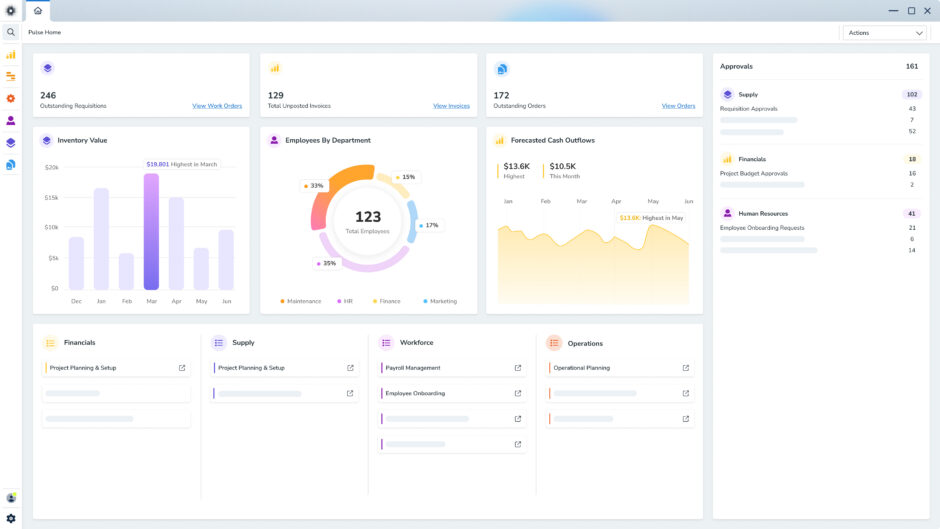
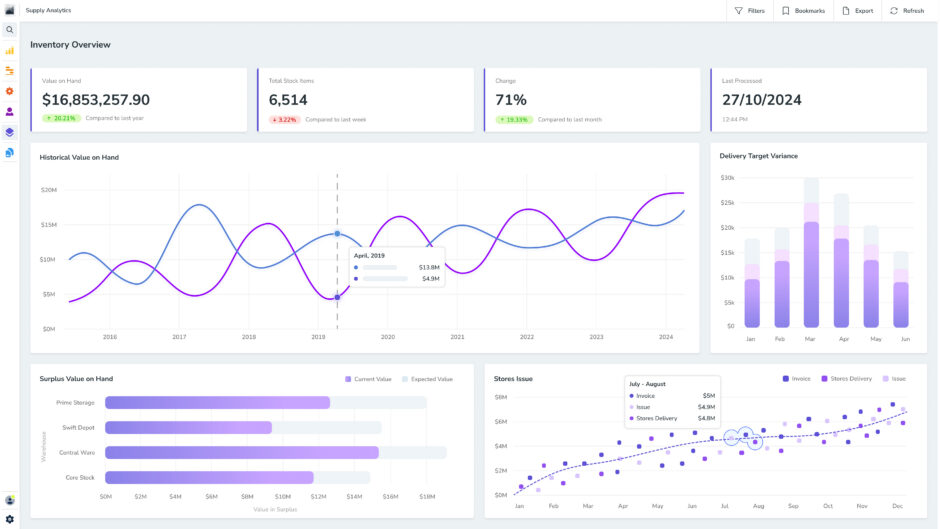
Pulse Supply provides a real-time view of stock levels, usage trends, and upcoming reorder points. As part of the Pulse ERP platform, this module integrates seamlessly with Pulse Financials and Pulse Maintenance, connecting inventory, procurement, and accounting data in one place.
As a result, your team can make faster, more informed decisions and streamline warehouse management from start to finish.