Inventory management is the process of overseeing and controlling goods from the moment they’re purchased or produced to their final sale.
From storage to replenishment, this core business function gives you clear visibility over your inventory needs. You need to know exactly what you have, where it is and what needs to be ordered next.
In this guide, we unpack how inventory management works, outline the most common techniques, and answer FAQs.
Keep reading to discover how to drive stronger supply chain performance with practical techniques and modern inventory software in 2026.
Inventory management 101
Inventory is often one of the largest costs sitting on a balance sheet. It takes up capital, space and time, yet doesn’t improve revenue until it’s sold and delivered.
That’s why effective inventory management is crucial.
Overall, the main goal is to keep the right amount of stock on hand to meet customer demand without tying up unnecessary cash in excess inventory.
When it’s tackled efficiently, your business can avoid two costly problems: running out of stock and missing out on sales, or holding too much stock and eroding profit through storage costs, damage or obsolescence.
Strong inventory management also improves agility. It can help your business stay on top of seasonal demand shifts, supplier delays and unexpected disruptions without compromising cash flow or customer satisfaction.
The main types of inventory management
Manual inventory systems
Manual inventory management is exactly what it sounds like. Stock is counted by hand and recorded in a notebook or spreadsheet. There’s no automation or real-time inventory visibility. Updates only happen when someone remembers to enter them.
For very small businesses with a tight product range and low sales volume, this low-cost method can work in the early days.
But as the business grows, cracks start to show. Spreadsheets become messy, counts fall out of sync and decisions are made on outdated information. What once felt cheap and simple can quickly become risky and time-consuming.
Periodic inventory systems
Periodic inventory management updates inventory records with physical stocktakes at specific intervals, be it monthly, quarterly or annually.
For accounting purposes, inventory at the beginning of the period is added to purchases made during the period. The closing stock figure is then subtracted to calculate the cost of goods sold.
Periodic systems often use barcodes and databases to support stocktaking, but the data between stock counts may not be fully up to date.
This approach can work for smaller operations or businesses with lower stock volumes, but it leaves room for discrepancies between counts.
Perpetual inventory systems
Perpetual inventory management tracks inventory in real time. Every sale, receipt, production run or return automatically updates stock levels through integrated software and scanning technology.
As the data is updated continuously, businesses can access an accurate view of stock at any moment. Physical stocktakes are still recommended, but they’re used to verify accuracy rather than rebuild records from scratch.
This inventory management method offers maximum visibility and control.
They’re typically integrated with accounting, point of sale, and ERP platforms like Pulse, making them the preferred choice for businesses managing multiple locations, high transaction volumes or complex supply chains.
10 inventory management methods
There’s no single way to manage inventory efficiently. The best approach depends on your product, industry, demand patterns and supply chain risk. Many businesses use a mix of methods to balance cost control, service levels and operational stability.
Here are the most common strategies for managing inventory:
ABC analysis
Not all products deserve the same level of attention. ABC analysis ranks goods based on inventory value and importance:
- A items are of high value and tightly controlled
- B items are of moderate value and monitored regularly
- C items are of lower value with minimal management needed
This categorisation helps to direct management where it will have the most significant financial impact.
First-in, first-out (FIFO)
FIFO assumes the stock you purchased or produced first is sold first. This method is particularly important for businesses dealing with perishable goods or products with expiry dates, as it reduces the risk of spoilage and write-offs.
From an accounting point of view, FIFO generally records older, lower-cost inventory as the cost of goods sold during periods of rising prices.
This often results in a lower cost of goods sold and a higher reported profit. The remaining stock on hand is valued at more recent purchase prices, which can provide a clearer reflection of current replacement costs.
Just-in-time (JIT) inventory management
JIT means ordering stock to arrive precisely when it’s needed. The goal is to reduce storage costs, boost efficiency and avoid excess inventory.
This technique works well when your forecasting is accurate, and you can count on your suppliers. That said, it leaves less room for error if supply chains are disrupted.
Safety stock
Safety stock is your buffer. It’s extra inventory held in case customer demand spikes, supply chains are disrupted, or deliveries are delayed.
The perfect amount of safety stock varies based on how quickly items sell, anticipated demand, supplier lead times and overall supply chain reliability.
While this method increases holding costs, it can also protect revenue and customer relationships during unexpected disruptions.
Economic order quantity (EOQ)
Every purchase order costs money. There’s admin time, freight and handling. Order too often, and those costs stack up. Order too much, and you tie up cash in storage, insurance and slow-moving stock.
EOQ calculates the most cost-effective order quantity. It weighs up annual demand, the cost of placing an order and the cost of holding inventory, and can be adjusted for real-world factors like seasonal swings, supplier discounts or warehouse space limits.
Material requirements planning (MRP)
MRP is mainly used in manufacturing. It calculates what raw materials are needed and exactly when they’re required for production.
When purchasing is aligned with production schedules and real customer demand, you avoid stockpiling unused materials and reduce the risk of delays caused by missing parts.
MRP is typically built into ERP systems for full operational visibility.
Radio Frequency Identification (RFID)
RFID uses wireless signals to identify and track products through a unique digital code. Each tagged item can be scanned remotely, enabling businesses to monitor its location and access detailed product information instantly.
This improves visibility across warehouses, speeds up receiving and dispatch and reduces manual scanning errors. It’s particularly useful for high-volume or high-value inventory environments.
Lean manufacturing
Lean manufacturing revolves around removing waste. It involves reducing excess stock, simplifying inventory processes and continuously reviewing levels to match real-time demand.
By trimming surplus investments and simplifying workflows, businesses can curb overheads and avoid passing avoidable costs on to customers. The result is tighter operations, healthier margins and a more responsive supply chain.
Reorder point (ROP)
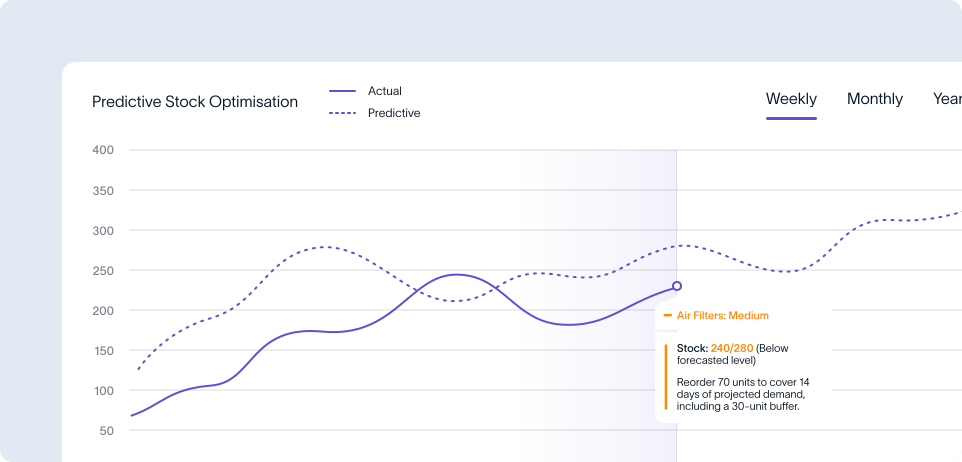
An ROP is the stock level that triggers a new order. It’s based on average demand and supplier lead times. When stock drops below the set level, replenishment kicks in to prevent the risk of running out.
Importantly, ROPs aren’t fixed. They can shift across the year or between products depending on seasonality, supplier lead times and changing sales trends. Reviewing them regularly helps keep inventory levels aligned with current demand.
Dropshipping
Dropshipping allows retailers to sell products without physically holding them. Instead, suppliers store and ship directly to customers.
This approach reduces upfront inventory investment but requires strong system integration to ensure stock data and delivery estimates stay on track.
Last-in, first-out (LIFO)
LIFO assumes the most recently purchased stock is sold first.
When prices are rising, this means the higher-cost, newer inventory is recorded as the cost of goods sold. As a result, reported profit appears lower because the expense per item is higher.
In some countries, this lower reported profit can reduce taxable income. However, LIFO isn’t allowed under Australian accounting standards.
Businesses in Australia must use approved methods such as FIFO or weighted average when valuing inventory for financial reporting.
The typical inventory management process
Inventory is handled differently in every organisation, based on its size, offering and operations. For instance, a small boutique with a limited collection will need a far simpler inventory management process than a global manufacturer managing hundreds of product ranges.
That said, the core steps tend to stay the same:
1. Planning
Everything depends on demand. To start, businesses analyse historical sales data, seasonal trends, marketing activity and broader market conditions to estimate what customers are likely to buy.
This planning sets the foundation for purchasing decisions, with precise forecasting helping to prevent over- or under-ordering.
2. Ordering
Purchase orders are raised based on forecasted demand and current stock levels. This can be done manually or triggered automatically by inventory software.
These ordering decisions factor in supplier lead times, minimum order quantities, freight costs, storage capacity and holding costs. The aim is to buy the ideal quantity at the perfect time, not too early and not too late.
3. Delivery
When goods arrive on site, they’re checked against purchase orders and supplier invoices. The purpose of this step is to confirm the quantity and condition before accepting inventory, whether it’s a raw material or a sale-ready product.
These days, many businesses use technology like barcode scanning to speed up receiving and reduce errors. Once deliveries are approved, inventory records are updated.
4. Review and storage
Stock is assigned a storage location, whether in a warehouse, retail store or distribution centre. Each item is recorded using identifiers like Stock Keeping Units (SKUs) or Universal Product Codes (UPCs) for straightforward physical inventory tracking.
At this stage, inventory management software helps to monitor stock levels and locations. Additionally, a logical, organised storage approach, such as careful labelling and categorisation, makes stock easy to find, pick, and manage.
5. Selling
When a customer places an order, the system confirms availability in real time. Items are pulled, packed and dispatched, with inventory levels updating automatically in an ideal system.
Once the order is shipped, inventory tracking supports on-time delivery and clear communication with customers about order status.
6. Auditing and reporting
Strong inventory management relies on data from start to finish. Regular stocktakes confirm that physical counts match system records.
At the same time, reporting tools can analyse key performance metrics like stock turnover, lead times, order accuracy and carrying costs.
From shipping fees to return rates, these insights are key to flagging inefficiencies and areas for improvement.
7. Reordering
As stock levels dip below specified thresholds, ROPs trigger replenishment. When this happens, many automated systems can instantly alert team members and generate purchase orders.
Importantly, replenishment strategies vary by product type, season or supplier performance. Reorder settings should be reviewed regularly to make sure they’re aligned with current demand and supply conditions.
What are the benefits of inventory management?
Inventory management directly affects sales, cash flow, customer experience and profitability. Managed well, its advantages are felt across the entire business.
Let’s take a look at each benefit.
Increased revenue
Revenue grows when customers can buy what they want, when they want it. Keeping the right stock on hand minimises lost sales from stockouts and keeps orders flowing without disruption.
Accurate inventory tracking also prevents over-ordering, which protects your margins and avoids cash being tied up in excess stock.
When you have clear insight into sales trends and product performance, you can back your best sellers, reduce slow-moving lines and allocate stock where it will generate the strongest return.
Higher customer satisfaction
Customers expect to receive the correct order on time. When your inventory data is accurate, you can confirm availability immediately, set realistic delivery expectations and avoid the frustration of unexpected backorders.
After all, consistent product availability builds trust. And trust is key to improving customer satisfaction for repeat sales.
Greater efficiency
Performing manual stock checks, chasing paperwork and searching for misplaced items slow teams down. Meanwhile, a structured inventory system helps to eliminate guesswork and repetitive admin.
When everyone knows what’s in stock and where it’s located, warehouse workflows become more organised, dependable and productive.
Improved cash flow
Inventory sitting on shelves represents money that could’ve been contributed to another area of your business.
Effective inventory management keeps stock levels aligned with demand, freeing up working capital and improving overall cash flow.
More precise forecasting
Rich and reliable inventory data sharpens demand forecasting. By analysing sales history, seasonality and stock movement patterns, businesses can plan purchasing with more accuracy.
That means fewer surprises, fewer emergency orders and fewer excess stock write-offs.
Reduced operational risk
Supply chain disruptions, seasonal demand shifts and supplier delays are part of doing business. With clear visibility over stock levels and lead times, you can act early instead of struggling under pressure.
This minimises the likelihood of production delays, lost sales and unnecessary rush freight costs.
Less waste
Excess, expired or obsolete stock erodes profit. Strong inventory systems help minimise spoilage and overstocking. Importantly, this waste reduction can translate to stronger margins and more sustainable operations.
When inventory is managed effectively, decisions can be based on facts, not assumptions. Costs come down, service improves, and your business can operate with far greater confidence.
What is an inventory management system?
An inventory management system is the process a business uses to track goods from the moment they’re ordered from a supplier through to when they’re bought and delivered to the customer.
This system gives you a live view of what stock you have, where it is, how fast it is moving and when you need to reorder. It records:
- Stock on hand
- Stock on order
- Stock allocated to customers
- Stock in transit
- Stock across multiple locations
This information flows through your entire supply chain, covering purchasing, production, warehousing and sales. Without it, you’re guessing. With it, you’re making smart, efficient decisions based on real-time data.
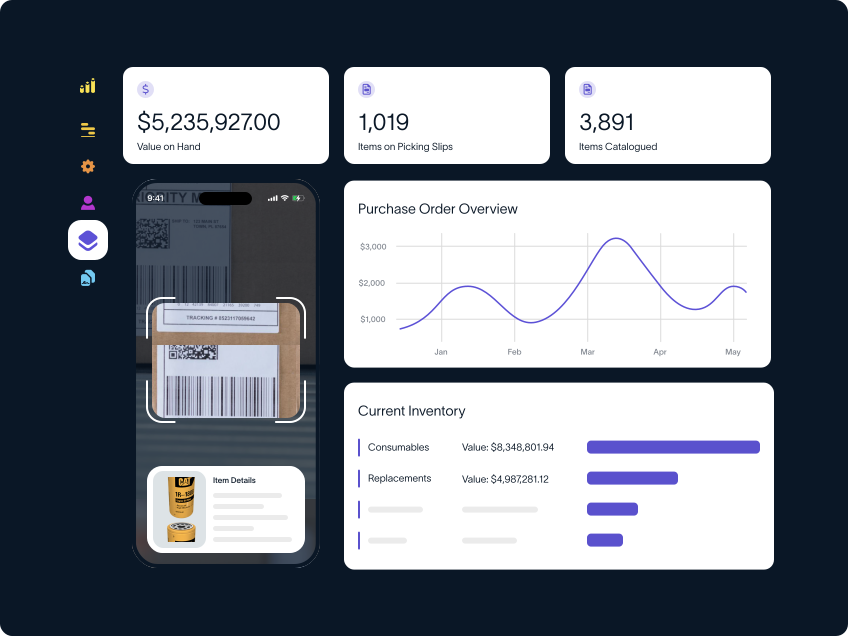
Today, online inventory management systems update automatically as goods move through supply chain touchpoints. Every sale, delivery, transfer or return is recorded instantly, giving you a live view of stock levels, product locations and when it is time to reorder.
Instead of relying on manual data entry, the inventory system automatically adjusts quantities and captures movement data in the background. The result is accurate, up-to-date visibility across teams, without the admin burden.
Some of these systems can also integrate with other core business platforms, including:
- Accounting software
- Ecommerce and point of sale systems
- Shipping and freight providers
- ERP systems
By connecting these tools, your business can benefit from a single source of truth across its supply chain.
How to choose inventory software for your supply chain
Not all inventory platforms are built the same, and no two businesses face identical stock challenges.
So, before comparing inventory management software options, it’s essential to understand where your supply chain processes are falling short.
Pinpointing your inventory management system pain points will help you choose a solution that addresses real operational issues instead of paying for features you don’t need.
When weighing up various solutions for inventory optimisation, focus on practical capability and long-term value.
Your inventory management software should offer these key features:
- Seamless integration with your existing ERP, accounting, ecommerce and point of sale systems, so data flows automatically without manual re-entry
- Live stock tracking across warehouses, retail sites and online channels to eliminate guesswork and reduce overselling or stockouts
- Automated reorder points and demand forecasting to help you purchase based on actual trends rather than assumptions
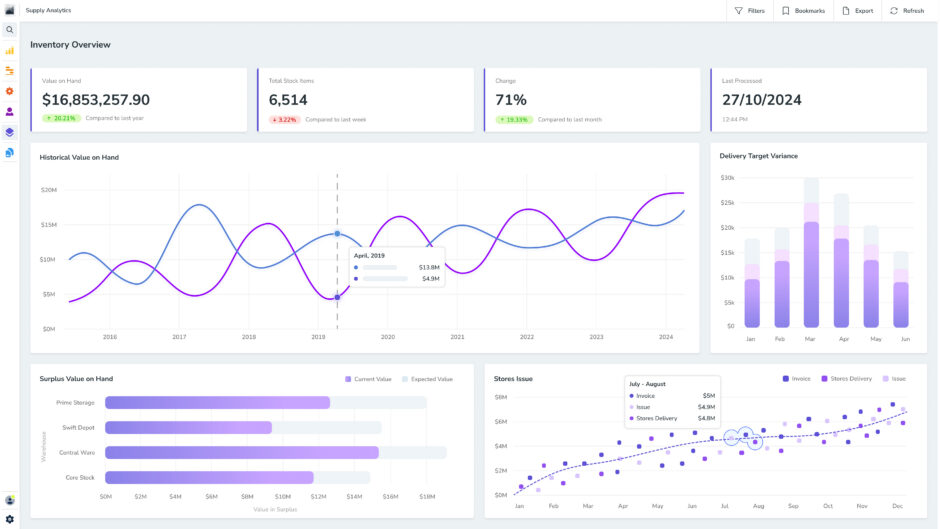
- Clear, built-in dashboards and reporting tools that highlight stock turnover, supplier performance and slow-moving inventory
- Real-time demand planning that allows you to adjust purchasing and warehouse activity as sales patterns shift
- Multi-location management to maintain control as your business grows
- Cloud-based access so teams in different locations can work from the same live data
- Transparent pricing that accounts for implementation, integration, training and ongoing support, not just the initial licence fee
- A proven vendor track record, strong local support and regular product updates
Enjoy these benefits and more with Pulse Supply. As a configurable ERP module, it connects seamlessly with other Pulse modules and third-party systems to create one clear, reliable view of inventory and procurement activity.
This is what you’ll gain:
- Stock control that adjusts to real usage patterns, helping you order with precision and avoid excess or shortages
- End-to-end procurement visibility so you can see exactly where every request, approval and supplier delivery stands at any moment
- Automated workflows for repetitive tasks like requisitions, purchase orders and invoice matching, which reduce errors and free your team to focus on cost control and supplier strategy
- Built-in compliance controls, including validation checks, audit trails and approval workflows, that protect governance standards and reduce financial risk
- Custom inventory reports that turn purchasing and inventory data into insights on spend, supplier reliability and process efficiency, making savings opportunities easier to spot
- Anywhere access with Pulse Mobile, which gives authorised users the ability to approve orders, track deliveries and review supplier details on the go, keeping teams connected and decisions moving
FAQs
Inventory refers to the goods a business holds to sell or to use in producing goods for sale. Essentially, it’s anything your business needs to restock to run smoothly and generate revenue.
Customers usually think of inventory as finished products ready to buy. For a business, it’s much broader.
There are four main types of inventory:
- Raw materials and components are the inputs used to create a finished product, like ingredients, packaging and labels.
- Work-in-progress inventory is stock that’s partway through the production process and not ready for sale yet.
- Finished goods are completed products that are packaged, labelled and ready for customers.
- Maintenance, repair and operating supplies (MRO) are the supporting items needed to keep operations running, such as cleaning products, tools or spare parts. They aren’t sold to customers but are key to production.
On a balance sheet, inventory is recorded as a current asset. It represents money tied up in stock that you expect to turn into sales.
While inventory creates the opportunity to earn income, it also uses working capital and incurs storage, insurance and handling costs. That’s why it must be managed carefully.
Inventory management is the overall strategy and process used to order, track, store and replenish stock. From purchasing and warehousing to forecasting and replenishment, it looks at the whole system to ensure the right products are available at the right time while controlling costs.
On the other hand, inventory optimisation is a specific part of inventory management. It focuses on finding the ideal stock levels to maximise profit, avoid stockouts and improve cash flow.
Ultimately, inventory optimisation is about using stock as efficiently as possible. Inventory management is the broader framework that makes that efficiency possible.
Inventory management is the big picture. It involves planning, forecasting demand, setting reorder points, analysing trends and aligning stock levels with business goals.
Meanwhile, inventory control is more specific and operational. It focuses on accuracy and movement within the warehouse or storage location, including stocktakes, barcode scanning, bin location systems and loss prevention procedures.
Strong inventory control supports strong inventory management. Without accurate data, you can’t make informed decisions about purchasing, pricing or forecasting.
Inventory management looks after your stock, answering the questions: What do we have, where is it, and when do we need more?
Its job is to make sure products are available when needed without tying up cash in excess stock. This includes purchasing, receiving deliveries, storing goods and keeping stock records accurate.
In contrast, order management answers a different question: How do we get this product to the customer quickly and correctly?
It starts the moment a customer places an order, centring on stock allocation, picking, packing and shipping.
In short, inventory management protects your stock levels, while order management protects your customer experience. Both are essential for a business that wants to grow without creating unnecessary friction behind the scenes.
Inventory control is critical to safeguarding your revenue and reputation because it helps to minimise two major risks:
- Stockouts: Not having enough stock leads to missed sales, delayed production and frustrated customers. For example, almost half of consumers report avoiding a business after experiencing stock-related issues.
- Overstocking: Buying too much inventory ties up working capital. It increases storage fees, insurance expenses and the risk of spoilage or obsolescence.
Remember that inventory is often one of a company’s largest assets. Without careful management, it can quickly become a financial burden.
While the principles and benefits of inventory management are universal, its application looks different depending on the industry.
Here are some real-world examples:
- Retail: Modern retailers rely on live sales data and automated reorder points to keep shelves full without drowning in excess stock. For example, a clothing store needs to predict future demand before a new season launches. If winter jackets arrive too late, sales are lost. If too many are ordered, they end up discounted.
- Manufacturing: Smart inventory management balances supply deliveries with production runs to protect cash flow and avoid delays. For instance, a manufacturer needs to align raw materials with production schedules. If timber, steel or components do not arrive on time, production stops. If too much is ordered, cash sits idle in the warehouse.
- Food and beverage: In this sector, good inventory management directly impacts profit. For example, a café manages highly perishable stock. Milk, fresh produce and baked goods have short shelf lives. Daily tracking of usage, waste and supplier lead times helps minimise spoilage and maintain healthy margins.
- Healthcare: Hospitals and pharmacies can’t afford stockouts of critical medications or equipment. To avoid this, they’ll use automated systems to track batch numbers, expiry dates and usage rates.
The most common inventory challenges for modern businesses include:
- Surplus stock: Extra inventory increases holding costs and risks becoming obsolete.
- Insufficient stock: Stockouts damage customer trust and reduce revenue.
- Inaccurate data: If stock levels are incorrect, reordering decisions will also be incorrect.
- Manual processes: Spreadsheets and paper systems increase errors and slow reporting.
- Changing demand: Customer preferences shift quickly. Without reliable data, it is difficult to adjust purchasing in time.
- Poor warehouse layout: If staff struggle to locate items, picking times increase and errors become more common.
Overcoming these obstacles demands smarter inventory management systems, quicker processes and accurate stock reviews.
You should consider upgrading your inventory management system if:
- You struggle with stock accuracy: If you cannot quickly confirm how many units you have on hand, it is time to review your system.
- Holding costs are climbing: Rising storage costs and extra stock may signal poor forecasting or limited reporting capability.
- Sales growth is slowing: If your team spends more time checking stock levels than serving customers, inefficiencies may be limiting growth.
- You rely on spreadsheets: Spreadsheets stand in the way of efficient, reliable and productive operations, lacking real-time visibility and multi-user access.
With a smart inventory management system, you’ll gain live updates, automated workflows and integrated reporting. For growing businesses, these tools often pay for themselves through improved accuracy and cash flow control.
Once you’re selling across multiple channels, holding stock in different locations or scaling quickly, manual systems become risky. Errors creep in. Data goes out of date. Decisions are made on incomplete information.
An Enterprise Resource Planning (ERP) system removes that friction. This streamlined platform brings key business functions, like inventory management, accounting, and maintenance, into one integrated system.
Instead of juggling spreadsheets and separate software, everything works together in real time. That means greater visibility, efficiency and control across your supply chain.
With an ERP system, you can:
- See exactly how much stock you have across all locations
- Automatically generate purchase orders when stock hits set levels
- Track inventory costs directly in your financial reports
- Manage multiple warehouses without manual reconciliation
Access one reliable source of data across your business
When your data is connected and current, you can make faster decisions with confidence and keep your business moving forward without duplicate keystrokes or second-guessing numbers.
Manage inventory seamlessly with Pulse Supply
To keep operations running at peak productivity, inventory management needs to be simple, efficient and reliable.
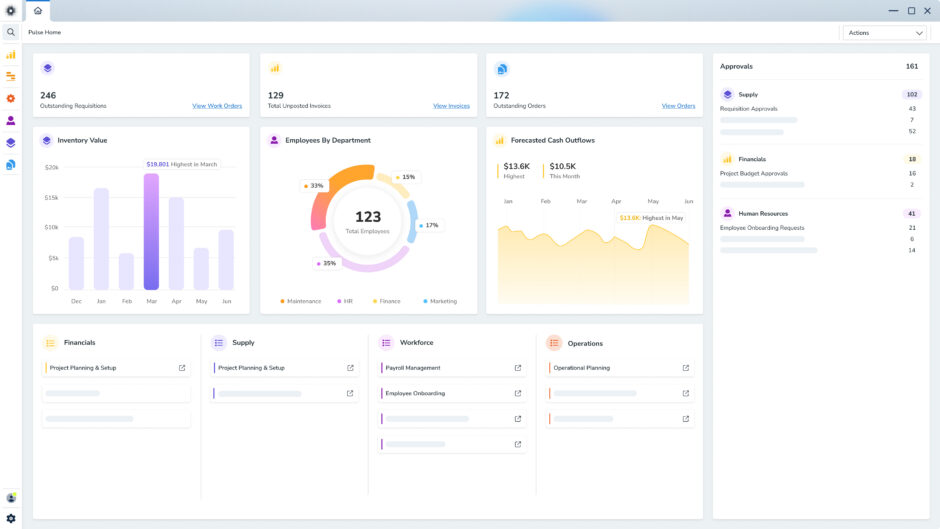
Get a live view of inventory levels, usage patterns and upcoming reorder points with Pulse Supply. This ERP module connects with Pulse Financials and Pulse Maintenance to streamline stock, procurement and accounting data in one place.
With real-time business-wide data at your fingertips, you can avoid stockouts, cut excess holding costs and make more confident purchasing decisions.